

Roadside assistance
Restarting without a second car, reinflating without a petrol station. Three products for the two failures that most often strand a car, and how to choose the right power.
Showing all 11 results
-
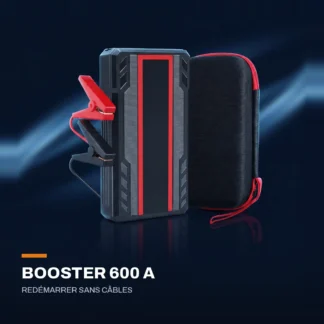
600 A battery booster — restart without cables or a second car
From 49,99 € Select options This product has multiple variants. The options may be chosen on the product page -
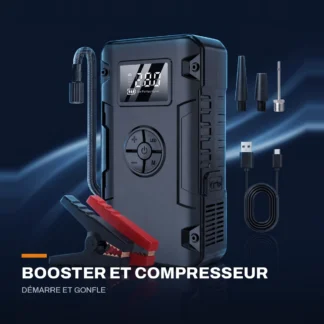
Battery booster with compressor — jump-starts and inflates
57,99 € Add to cart Buy now -
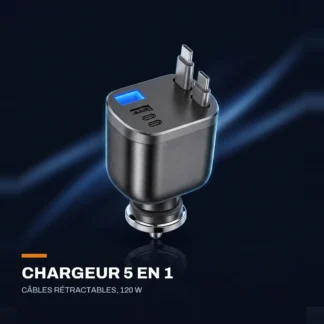
5-in-1 cigarette lighter charger — two retractable cables, 120 W
21,99 € Add to cart Buy now -

CARSUN cordless tyre inflator — automatic stop, display
30,99 € Add to cart Buy now -

Tire plug repair kit — no wheel removal needed
12,99 € Select options This product has multiple variants. The options may be chosen on the product page -

Magnetic LED Work Light — rechargeable, warning lights
19,99 € Select options This product has multiple variants. The options may be chosen on the product page -

Heavy-duty jumper cables — copper cables, thick gauge
15,99 € Select options This product has multiple variants. The options may be chosen on the product page -

Inflator gun with pressure gauge — compressor fitting
19,99 € Select options This product has multiple variants. The options may be chosen on the product page -

Tow Strap with Metal Hook — up to 5 meters
12,99 € Select options This product has multiple variants. The options may be chosen on the product page -
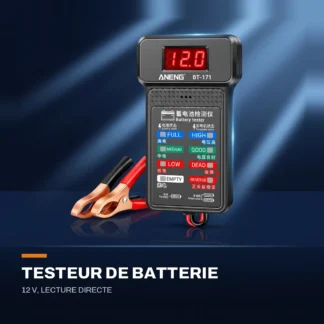
12V Battery Tester — check charge status at a glance
16,99 € Select options This product has multiple variants. The options may be chosen on the product page -

OBD2 Bluetooth diagnostic scanner — read and clear fault codes
17,99 € Select options This product has multiple variants. The options may be chosen on the product page
Showing all 11 results
The battery, the first cause of a breakdown
Nearly half of all roadside call-outs involve the battery, and the proportion climbs higher still in December and January: cold reduces the available capacity at exactly the moment the starter, the heating and the headlights are asking for most. A battery that struggles to start in November almost always leaves its owner stranded in January.
A self-contained booster replaces the second car and the cables. It fits in the glovebox, recharges over USB and doubles as a power bank.
Choosing the amperage
- Up to 2.0 L petrol : 400 to 600 A is plenty, cold weather included.
- Diesel up to 2.5 L : aim for 600 A as a minimum, a diesel starter asks for more when cold because of the compression.
- Beyond that, large diesels and vans : you need to go up to 1,000 A and beyond.
Two figures deserve to be told apart. The peak current, the one pushed on the packaging, lasts only a fraction of a second; the cranking current, which is lower, is the one that actually counts. And a booster is recharged two or three times a year even when unused: a unit left in the boot for two winters is flat on the day you need it.
Tyre pressure: what neglecting it costs you
A tyre 0.5 bar under-inflated increases fuel consumption by about 2.5%, lengthens the braking distance and wears faster on the shoulders. Pressure is checked cold, on tyres that have not run more than a few kilometres: measured after an hour on the motorway, it reads about 0.3 bar high.
A cordless inflator with automatic stop handles the everyday case — checking and adjusting every month without queuing at the petrol station. Allow one to two minutes per tyre for an adjustment, longer for a flat tyre, and check that the figure shown matches the one on the label in the door pillar, which often differs between front and rear.
One device or two
A booster with a built-in compressor covers both failures in a single unit and saves charging two devices. It is bulkier and heavier than a booster alone. If the car stays in town with petrol stations nearby, a compact booster is enough; for long journeys, the countryside or a vehicle that sleeps outside, the combined version is the better compromise.
The questions we get asked
- How powerful a booster do I need for my car?
- 400 to 600 A for a petrol engine up to 2.0 L, at least 600 A for a diesel up to 2.5 L, 1,000 A and above beyond that. A diesel asks for more when cold because of its compression.
- Can a booster stay in the boot permanently?
- Yes, provided you recharge it two or three times a year even without using it. A lithium battery slowly discharges on its own: a booster forgotten for two winters is flat on the day you break down.
- When should you check your tyre pressure?
- Cold, before you have driven more than a few kilometres. Measured after a journey, the pressure reads about 0.3 bar high, which leads to under-inflating.